

Your real estate website can look professional, have hundreds of property listings, and still struggle to appear on Google. The problem is often not the number of pages you have. Small real estate SEO mistakes can make it harder for Google to understand your website and harder for potential buyers to find your business.
This can lead to lower search rankings, less organic traffic, poor search visibility, and fewer real estate leads. For a real estate agent, broker, property dealer, or agency, losing visibility in Google search can mean losing potential buyers and sellers to competitors.
The problem is not always a Google algorithm update. Many ranking problems come from basic issues on the website itself. Wrong keywords, duplicate property content, weak location pages, poor internal linking, technical SEO errors, and weak local SEO can all affect your search presence.
In this guide, we will look at the most common real estate SEO mistakes, explain why they can hurt your Google rankings, and show you practical ways to find and fix them.
How SEO Mistakes Can Hurt a Real Estate Business
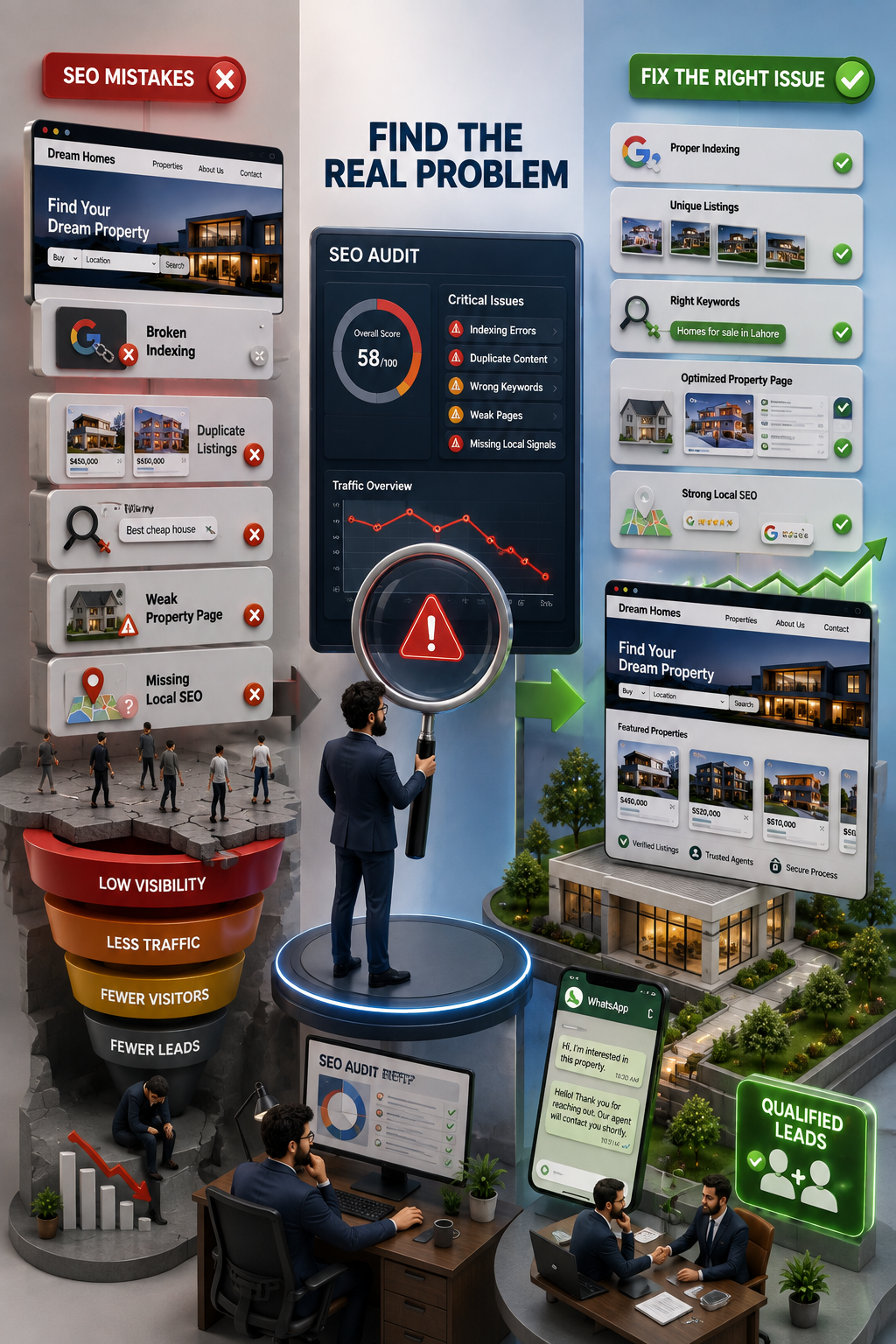
SEO mistakes can affect more than your Google rankings. They can affect how easily potential buyers and sellers find your real estate business online. When important SEO problems are left unfixed, your website may lose search visibility and receive less organic traffic. Fewer relevant visitors can then mean fewer potential buyers, sellers, and real estate leads.
The process can be simple:
SEO Mistake → Lower Visibility → Less Organic Traffic → Fewer Potential Buyers → Fewer Leads
But not every ranking problem means you need more content. Sometimes the real problem is technical SEO. In other cases, you may be targeting the wrong keywords, using duplicate content on property pages, missing important local SEO signals, or providing weak property pages.
For example, adding more articles will not fix a property page that Google cannot index. More content will not help much if you are targeting keywords that your potential buyers do not search for.
The first step is to find the real problem. Once you know what is stopping your website from performing well, you can fix the right issue instead of simply adding more pages.
8 Real Estate SEO Mistakes That Can Hurt Your Google Rankings
1. Targeting the Wrong Real Estate Keywords
One of the most common real estate SEO mistakes is choosing keywords that do not match what your potential customers are actually searching for.
For example, a real estate business may try to rank for a broad keyword such as “real estate.” This keyword is difficult to target and does not clearly tell you what the person wants. They may be looking for a definition, a real estate course, investment information, an agent, or a property.
A person searching for “houses for sale in San Francisco” has a much clearer reason for using Google. They may already be looking for a property and could become a potential buyer.
Why It Hurts Your Rankings and Leads
When you target the wrong keywords, your website may attract people who are not interested in your services or properties. You may see website traffic in your analytics, but that traffic may not turn into qualified leads.
You can also miss important searches where your real estate business should be visible.
Your keyword strategy should match the real people you want to reach.
How to Fix It
Start your keyword research by looking at:
- Location: city, area, neighborhood, or community
- Property type: houses, apartments, plots, commercial property, or other properties
- Buyer intent: searches from people looking to buy
- Seller intent: searches from people looking to sell
- Investment intent: searches from people researching property investment
For example, instead of only targeting “real estate,” a business serving Lahore could target useful searches such as:
- Houses for sale in Lahore
- Apartments for sale in Lahore
- Commercial property in Lahore
- Property dealer in Lahore
- Plots for sale in Lahore
The goal is not to use the biggest keyword. The goal is to target relevant keywords that connect your real estate business with people who are likely to need your services.
Good keyword research helps your website attract the right audience, improve search visibility, and create better opportunities for qualified real estate leads.
2. Using Duplicate Content on Property Listings
Another common real estate SEO mistake is using the same description on many property pages.
For example, imagine you have 20 houses listed on your website, but every page uses almost the same text:
“Beautiful property available for sale. Contact us for details.”
The properties may be different, but the pages do not give Google or the visitor much information about what makes each property special.
Why It Hurts
Property listings should give useful information about the specific property. When several pages have the same or very similar content, those pages may provide little unique value to users.
It can also make it harder for Google to understand which page is the best result for a particular search.
More importantly, duplicate descriptions are not helpful for buyers. A person looking for a three-bedroom house wants to know about that specific house, not read the same description they have already seen on several other listings.
A strong property page should answer the questions a potential buyer is likely to have.
How to Fix It
Create a useful and unique description for every property listing. Include details that are actually different for that property, such as:
- Unique description: Explain what makes the property different.
- Location: Mention the city, area, neighborhood, and useful nearby places.
- Property details: Include property type, size, bedrooms, bathrooms, price, and availability where appropriate.
- Amenities: Mention parking, security, garden, balcony, swimming pool, or other relevant features.
- Nearby places: Add useful information about schools, hospitals, shopping areas, roads, parks, or other important locations.
- Original images: Use genuine photos of the property instead of generic stock images.
- FAQs: Answer common questions about the property, viewing process, price, location, or other important details.
For example, instead of saying:
“Beautiful house available for sale. Contact us for details.”
explain what the buyer actually needs to know:
“This 3-bedroom house is located in [area] and includes a private parking space, modern kitchen, two bathrooms, and easy access to [nearby location]. The property is suitable for families looking for a home close to schools and local facilities.”
The description should always be accurate. Do not add features, locations, prices, or claims that the property does not have.
3. Creating Thin Location Pages
A common real estate SEO mistake is creating location pages only to target keywords without giving visitors useful information about the area.
For example, a real estate website may create pages like:
- Real Estate in Fresno
- Real Estate Long Beach
- Real Estate in Oakland
- Real Estate in Bakersfield
But every page may have almost the same content. Only the city name is changed.
This does not give potential buyers much useful information about the local market or the properties available there.
Why It Hurts
People searching for real estate usually want information about a specific place. They may want to know which properties are available, what areas are popular, what property types they can find, and what they should consider before buying.
A thin location page may not answer these questions.
It can also make your website look like it is creating pages mainly for search engines rather than helping real people. Simply changing the location name on the same page does not make the content useful or unique.
For example, someone searching for “houses for sale in Irvine” needs more than a page that says:
“We offer houses for sale in Lahore. Contact us for more information.”
They need real information about the properties and the location.
How to Fix It
Create location pages only for areas where your real estate business actually operates or has useful information to offer.
A helpful location page can include:
- Local property market information
- Property types available in the area
- Popular neighborhoods
- Nearby schools, hospitals, shopping areas, and transport
- Available properties
- Local buying or selling considerations
- Useful property price information where reliable
- FAQs about the area
- Links to related property pages
For example, a page about “Houses for Sale in [Area]” could explain the types of houses available, important nearby locations, property sizes, common buyer questions, and current listings.
Do not create hundreds of location pages just because you found many location keywords. Each page should have a clear reason to exist and should provide information that is useful to people looking for property in that area.
A good location page should help both Google and potential buyers understand exactly what your business offers in that location.
4. Ignoring Local SEO
Another important real estate SEO mistake is ignoring local SEO. Real estate is closely connected to location because most buyers and sellers are looking for properties, agents, brokers, or property dealers in a specific city or area.
If your business serves a particular location but your website does not clearly show where you work, Google may have a harder time connecting your business with relevant local searches.
For example, a person may search:
- Property dealer in Colorado
- Real estate agent near me
- Houses for sale in Washington
- Apartments for sale in Illinois
- Commercial property in Nevada
If your competitors have stronger local SEO signals, they may appear before your business.
Why It Hurts
Local search visibility can bring people who are much more likely to become real estate leads.
A visitor searching for “property dealer in Indiana” already has a local need. If your business is not visible for that search, a competitor may get the call or inquiry instead.
Common local SEO problems include:
- Incomplete Google Business Profile
- Incorrect business information
- Inconsistent name, address, or phone number
- Few genuine customer reviews
- Weak location pages
- Missing local keywords
- Limited information about the areas you serve
These problems can make it harder for both Google and potential customers to understand where your real estate business operates.
How to Fix It
Start by making your Google Business Profile complete and accurate. Make sure your business name, address, phone number, website, services, business hours, photos, and other important details are correct.
Then make your website clearly show the locations you serve. Create useful location-based content where it makes sense and naturally include relevant city, area, and neighborhood terms.
You should also encourage genuine customers to leave honest reviews about their experience with your business.
Keep your business information consistent across important online profiles and directories.
Most importantly, do not try to add a location keyword everywhere just to rank. Use location information where it helps the reader understand your business and services.
Strong local SEO helps your real estate business become easier to find when people in your target area are actively searching for property services.
5. Poor On-Page SEO
Another common real estate SEO mistake is leaving important website pages without proper on-page SEO. Your property pages, service pages, location pages, and other important pages should make it clear what each page is about.
For example, a property page may have a title like:
“Home Page | ABC Real Estate”
even though the page is actually about a house for sale in a specific area.
This gives Google and visitors very little useful information about the page.
Why It Hurts
On-page SEO helps search engines understand the topic and purpose of a page. It also helps users decide whether a search result is relevant to what they need.
Important on-page elements include:
- Meta title
- Meta description
- H1 heading
- H2 and H3 headings
- Page URL
- Relevant keywords
- Image alt text
- Internal links
- Useful page content
If these elements are missing, unclear, or poorly written, your pages may not communicate their topic clearly.
For example, instead of a generic title such as:
“Property Listing | ABC Real Estate”
a more useful title could be:
“3-Bedroom House for Sale in [Area] | ABC Real Estate”
This immediately tells both the visitor and Google what the page is about.
How to Fix It
Review your most important pages and make sure each one has a clear purpose.
Use a relevant meta title that describes the page and naturally includes the main keyword. Write a useful meta description that explains what the visitor will find on the page.
Use one clear H1 heading, then organize the rest of the content with relevant H2 and H3 headings.
Keep URLs simple and descriptive. For example:
/houses-for-sale-[area]/
is easier to understand than:
/page?id=4587
Add descriptive alt text to important property images where appropriate, and connect related pages with useful internal links.
For example, a location page about Houses for Sale in [Area] can link to individual property listings, while those property pages can link back to the relevant location page.
Good on-page SEO does not mean adding the same keyword again and again. It means making each page clear, useful, and easy for both visitors and search engines to understand.
6. Ignoring Technical SEO
A real estate website can have great property listings and useful content, but technical SEO problems can still stop important pages from appearing properly in Google.
Technical SEO is about making sure search engines can crawl, understand, and index your website correctly.
For example, you may have a valuable property page, but if Google cannot access or index that page, potential buyers may never find it through organic search.
Why It Hurts
Technical problems can affect your search visibility and prevent important pages from performing as they should.
Common problems on real estate websites include:
- Pages that are not indexed
- Broken links
- Incorrect canonical URLs
- Sitemap problems
- Incorrect robots.txt rules
- Slow-loading pages
- Mobile usability problems
- Duplicate URLs
- Pages returning errors
For example, if a robots.txt file accidentally blocks an important section of your property listings, search engines may have difficulty accessing those pages.
Similarly, if a property page has an incorrect canonical URL pointing to another page, Google may choose a different URL instead of the page you want to rank.
How to Fix It
Start by checking Google Search Console. Look for indexing issues, pages that Google cannot access, and other warnings related to your website.
Make sure your XML sitemap contains the important pages you want search engines to discover and that it is properly submitted to Google Search Console.
Check your robots.txt file and make sure you are not accidentally blocking important property, location, or service pages.
Review canonical URLs to make sure similar or duplicate pages point to the correct preferred URL.
You should also check for broken internal links and pages that return errors. Fix or redirect URLs when necessary.
Finally, test your website on mobile devices and monitor page speed and Core Web Vitals.
You do not need to change technical settings without knowing what they do. A small technical mistake can affect many pages at once, so important changes should be checked carefully.
Technical SEO gives your property pages a better chance of being discovered, crawled, indexed, and shown to the right people in Google search.
7. Weak Internal Linking
Another common real estate SEO mistake is not connecting related pages properly with internal links.
A real estate website can have many useful pages, such as property listings, location pages, service pages, blog posts, and guides. But if these pages are not linked together, both visitors and search engines may have difficulty finding important content.
For example, you may have a page about Houses for Sale in [Area] and several individual property listings in that area. If the pages are not connected with relevant internal links, visitors may not discover all the available properties.
Why It Hurts
Internal links help search engines understand how different pages on your website are related.
They also help visitors move from one useful page to another without having to return to Google.
Weak internal linking can leave important property pages several clicks away from your main pages. It can also make it harder to show the relationship between your real estate services, locations, and property listings.
For example:
Real Estate in [City]
↓
Houses for Sale in [Area]
↓
3-Bedroom House for Sale
↓
Schedule a Property Viewing
This creates a clear path for both the visitor and search engines.
How to Fix It
Review your important pages and look for natural opportunities to add internal links.
For example:
- Link your Real Estate in [City] page to important area pages.
- Link area pages to relevant property listings.
- Link property pages back to their relevant location pages.
- Link related blog posts to useful service and property pages.
- Link supporting articles back to your SEO For Real Estate pillar page.
Use descriptive anchor text that tells the reader what they will find after clicking.
For example, instead of:
“Click here”
use:
“Houses for Sale in [Area]”
or:
“Real Estate Services in [City]”
Do not add links just to increase the number of links on a page. Each internal link should help the visitor find something useful.
A well-planned internal linking structure makes your real estate website easier to navigate and helps search engines understand the relationship between your important pages.
8. Publishing Content Without Real Value
One of the biggest real estate SEO mistakes is publishing content only because you want to target more keywords.
A real estate website may have many blog posts, location pages, or property articles, but if the content does not answer real questions or help potential buyers and sellers, simply adding more pages will not solve the problem.
For example, an article titled “Best Properties in [City]” may sound useful, but if it only contains a few general sentences and does not explain the properties, areas, prices, or important buying points, the visitor gets very little value from it.
Why It Hurts
People use Google because they want an answer.
A potential buyer may want to know:
- Which areas are good for buying a house?
- What type of property is available?
- What should I check before buying?
- What is important when choosing a property?
- Which properties are available in my budget?
- How can I contact a reliable real estate agent?
If your content does not answer these questions, visitors may leave your website and look somewhere else.
Weak content can also make your website less useful as a whole. Publishing many pages that say the same thing does not automatically improve your organic traffic or search visibility.
How to Fix It
Create content based on real questions and needs of your target audience.
For example, instead of writing a general article about property, create useful content such as:
- Houses for Sale in [Location]: What Buyers Should Know
- Best Areas to Buy Property in [City]
- Things to Check Before Buying a House
- Commercial Property Investment Guide for [Location]
- How to Choose a Real Estate Agent
- Property Buying Questions Buyers Should Ask
Add real knowledge and useful details wherever possible. Use local market experience, genuine property examples, clear explanations, original images, customer questions, and accurate information.
Your content should also show who is behind the business. Clear company information, real team details, local experience, genuine reviews, and accurate property information can help build trust.
Do not write content simply to place real estate SEO keywords on a page. Write it because someone needs the information.
The goal is simple: create pages that are useful enough for a real estate buyer, seller, or investor to stay, learn something, trust your business, and take the next step.
How to Fix Real Estate SEO Mistakes
Finding SEO mistakes is only the first step. The next step is to fix the problems that are having the biggest effect on your real estate website. You do not need to change everything at once. Start with the pages that are most important for your business.
Step 1: Run a Technical SEO Audit
Check indexing, broken links, sitemap, robots.txt, canonical URLs, mobile usability, and page speed.
Step 2: Review Your Keyword Strategy
Make sure your target keywords match your locations, property types, and buyer, seller, or investment intent.
Step 3: Improve Important Property Pages
Add useful and unique property information, clear headings, images, FAQs, and relevant CTAs.
Step 4: Fix Duplicate and Thin Content
Rewrite duplicate property descriptions and improve location pages that provide very little useful information.
Step 5: Strengthen Local SEO
Improve your Google Business Profile, reviews, business information, and location-focused pages.
Step 6: Improve Internal Linking
Connect related property, location, service, and content pages with useful internal links.
Step 7: Create Useful Location and Content Pages
Build pages that answer real questions and provide information your target audience can actually use.
Step 8: Monitor Google Search Console
Track indexing, search queries, impressions, clicks, and changes in search performance.
Do not try to fix everything at once. Start with the SEO problems affecting your most important pages, then work through the rest step by step.
Real Estate SEO Mistakes Checklist
Use this quick checklist to find common real estate SEO mistakes on your website. You do not need to fix every item on the same day. Start with the areas that are causing the biggest problems.
Keywords
- Buyer-intent keywords targeted
- Location keywords targeted
- Property-type keywords targeted
Content
- Unique property descriptions
- No thin location pages
- Useful local content
On-Page SEO
- Clear title tags
- Useful meta descriptions
- Proper H1, H2, and H3 structure
- Relevant internal links
- Optimized property images and alt text
Technical SEO
- Important pages are indexed
- XML sitemap is working
- Canonical URLs are correct
- Robots.txt is not blocking important pages
- Website works properly on mobile
- Pages load at a good speed
Local SEO
- Google Business Profile is complete
- Genuine customer reviews are available
- Business name, address, and phone information is consistent
- Useful location pages are available
Final Takeaway

Good real estate SEO is not about adding keywords everywhere. It is about making your website easy for Google to understand and genuinely useful for people looking for property.
If your Google rankings are dropping, do not immediately publish 50 more articles. First, find the actual problem.
Wrong keywords? Fix your keyword targeting.
Duplicate property listings? Improve the content and add useful details.
Weak local visibility? Strengthen your local SEO and Google Business Profile.
Technical issues? Fix indexing, sitemap, canonical, mobile, and other website problems.
Poor internal linking? Connect related property, location, service, and content pages.
Once the real problem is clear, the solution becomes much easier to plan.
If you are unsure what is hurting your website’s search visibility, a Real Estate SEO Audit can help you find the problems and identify the right fixes before spending more time creating content.