

Why Your Real Estate Website Is Not Getting Leads
Your real estate website may be online. Your property listings may be live. You may even be getting visitors from Google. But if people are not calling you, sending a WhatsApp message, filling out your contact form, or asking about a property, there is a problem.
Having a website is not enough to grow a real estate business. Your website should help the right people find your business, learn about your properties, trust your services, and take the next step.
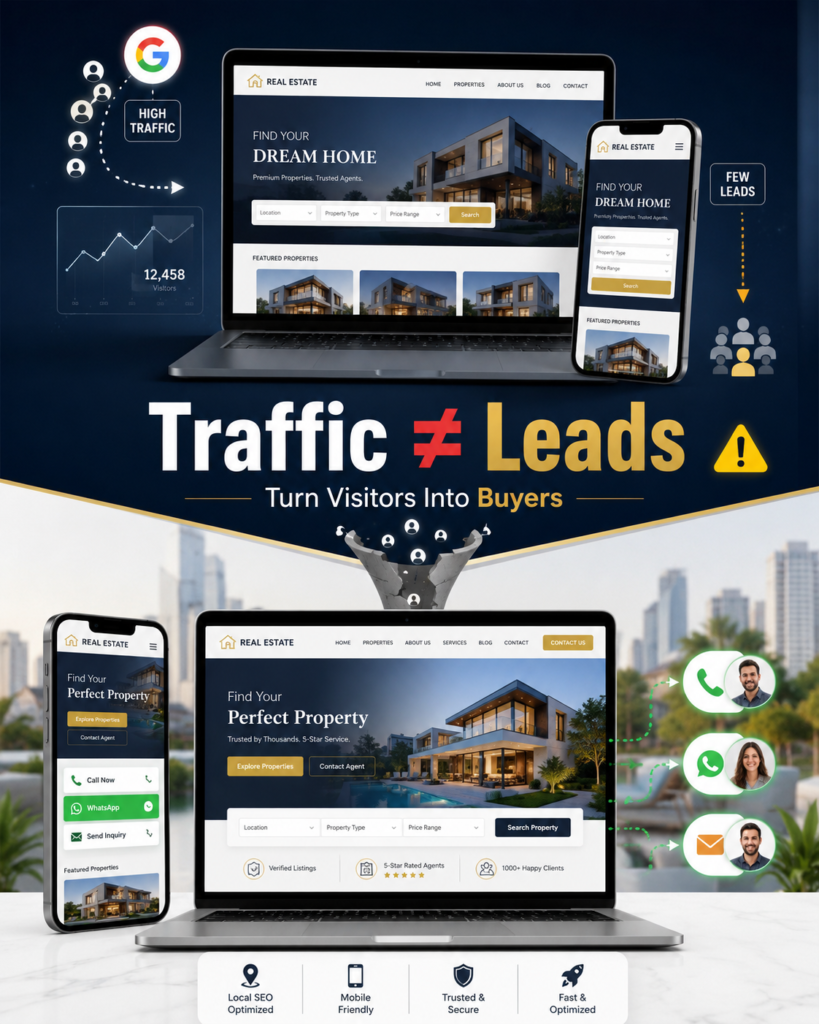
One common mistake is to think that website traffic means leads. It does not. You can have hundreds or thousands of website visitors and still get very few inquiries if those visitors are not the right buyers, your pages do not match their search, or your website makes it difficult to contact you.
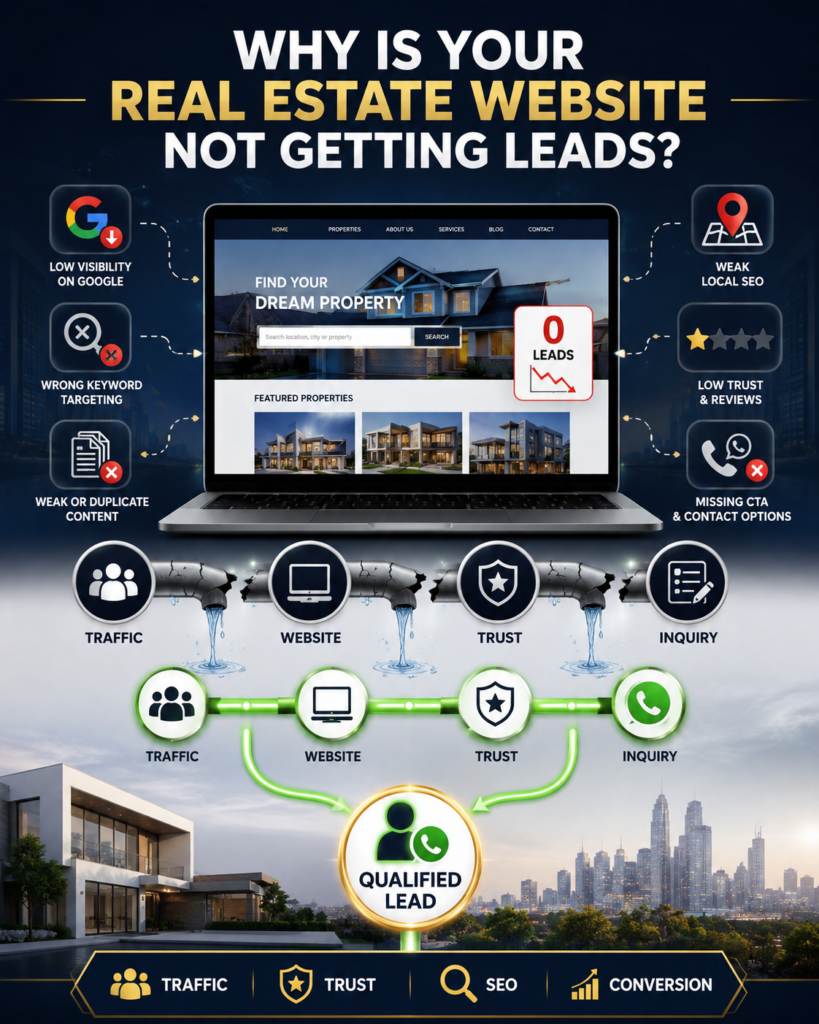
There can be many reasons why a real estate website is not getting leads. Your website may not be ranking for the right keywords. Your property pages may have weak or duplicate content. Your local SEO may be poor. Visitors may not trust the business yet. Your contact form may be difficult to use, or your call and WhatsApp options may not be easy to find. A slow or poorly designed mobile website can also make potential buyers leave.
In this guide, we will look at the most common reasons a real estate website gets traffic but does not generate enough leads. More importantly, we will show you how to find the real problem and what you can do to fix it.
Why Is Your Real Estate Website Not Getting Leads?
If your real estate website is not getting leads, the problem is not always the website itself. Sometimes people cannot find you on Google. Sometimes the website gets visitors, but those visitors are not looking to buy, sell, rent, or invest in property. In other cases, the right people visit your website but leave without making an inquiry.
There are several reasons this can happen. Your website may be targeting the wrong keywords, so you get traffic from people who are not your potential clients. Your property pages may have weak or duplicate content. Your local SEO may not be strong enough to reach buyers searching for properties in a specific city or area.
Trust is another important part of real estate lead generation. People want to know who they are dealing with before they share their phone number or ask about a property. Missing reviews, testimonials, company information, property details, or clear contact information can reduce buyer confidence.
Your call to action (CTA) also matters. If visitors cannot easily find your phone number, WhatsApp button, contact form, or property viewing option, they may simply leave.
It is also important to separate a traffic problem from a conversion problem. For example, 100 visitors and 0 leads may mean you need better targeting or a better website. But 10,000 visitors and only 5 leads may point to a conversion problem. Both situations need different solutions.
The first step is to find exactly where potential clients are leaving your sales funnel.
First, Find Out Where You Are Losing Potential Clients
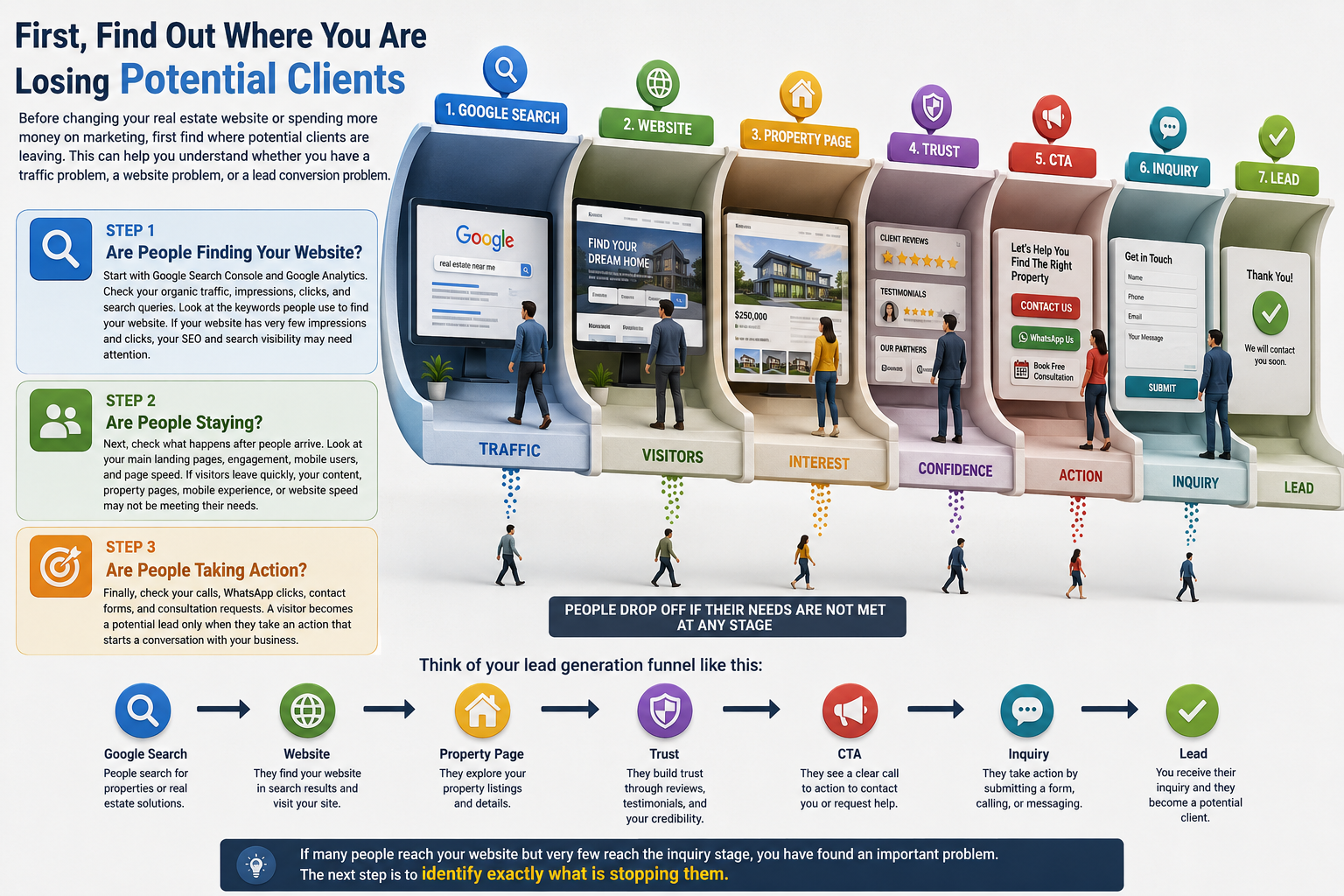
Before changing your real estate website or spending more money on marketing, first find where potential clients are leaving. This can help you understand whether you have a traffic problem, a website problem, or a lead conversion problem.
Step 1: Are People Finding Your Website?
Start with Google Search Console and Google Analytics. Check your organic traffic, impressions, clicks, and search queries. Look at the keywords people use to find your website. If your website has very few impressions and clicks, your SEO and search visibility may need attention.
Step 2: Are People Staying?
Next, check what happens after people arrive. Look at your main landing pages, engagement, mobile users, and page speed. If visitors leave quickly, your content, property pages, mobile experience, or website speed may not be meeting their needs.
Step 3: Are People Taking Action?
Finally, check your calls, WhatsApp clicks, contact forms, and consultation requests. A visitor becomes a potential lead only when they take an action that starts a conversation with your business.
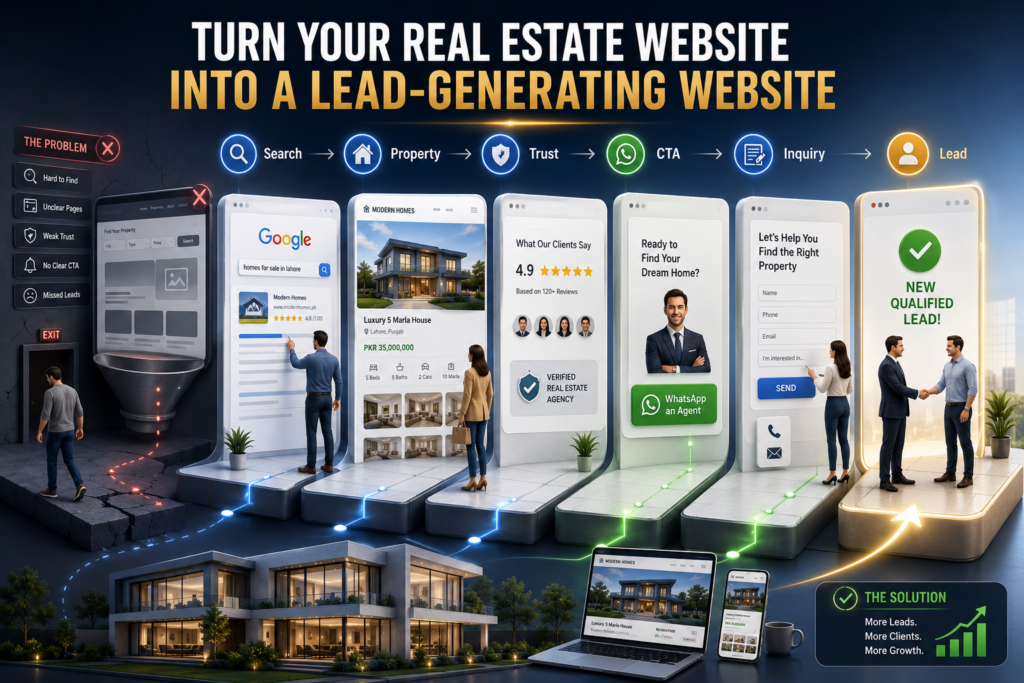
Think of your lead generation funnel like this:
Google Search → Website → Property Page → Trust → CTA → Inquiry → Lead If many people reach your website but very few reach the inquiry stage, you have found an important problem. The next step is to identify exactly what is stopping them.
10 Reasons Your Real Estate Website Is Not Getting Leads
A real estate website can have many small problems that stop potential buyers, sellers, tenants, and investors from contacting you. Sometimes the problem is SEO. Sometimes it is the property page, website design, trust, mobile experience, or the way visitors are asked to take action.
The important thing is not to guess. Find the problem first, then fix it.
1. Your Website Is Getting the Wrong Traffic
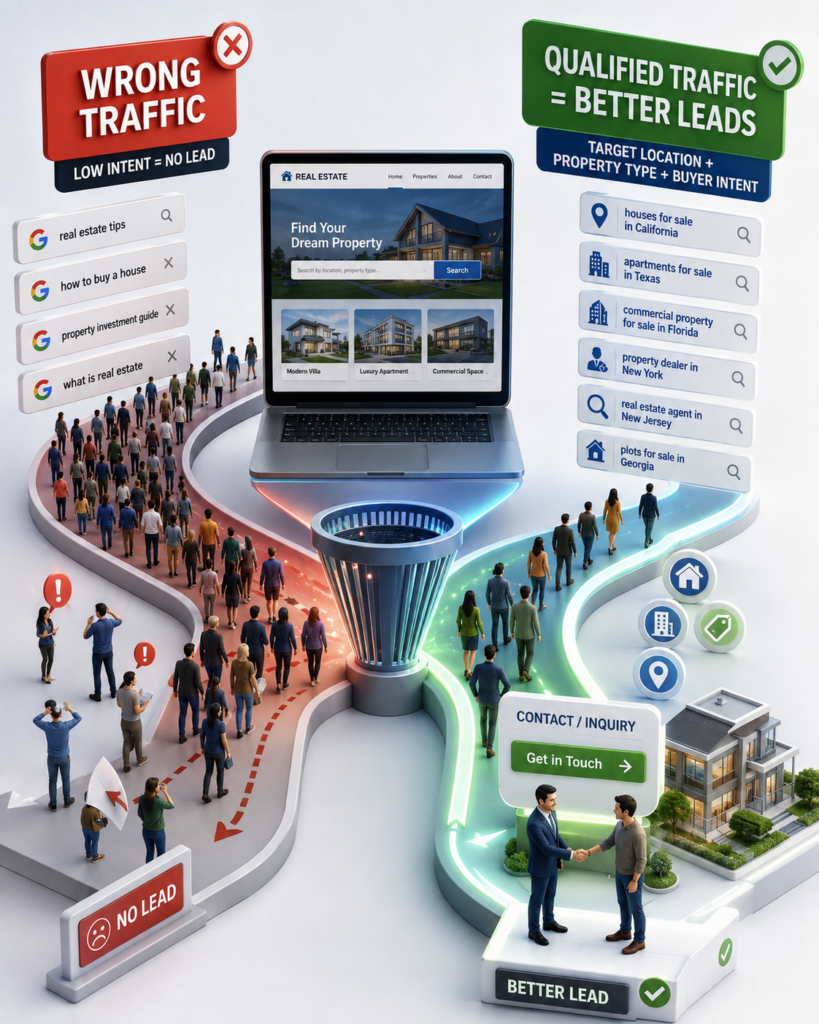
One of the biggest reasons a real estate website is not getting leads is that it is attracting the wrong people.
You may look at your Google Analytics report and see that your website is getting visitors. That may seem like a good sign, but website traffic alone does not mean you are reaching potential clients.
For example, imagine you sell luxury homes in Lahore. Your website may receive visitors from searches such as “real estate tips,” “how to buy a house,” or “property investment guide.” These searches can bring traffic, but many of those visitors may not be looking for a property or a real estate agent right now.
What you need is qualified traffic. These are people who have a real reason to contact your business.
Look for searches such as:
- houses for sale in California
- apartments for sale in Texas
- commercial property for sale in Florida
- property dealer in New York
- real estate agent in New Jersey
- plots for sale in Georgia
These searches show a stronger connection between the user’s need and your real estate services.
The solution is to build your SEO and content around the people you actually want to serve. Look at the location, property type, price range, and reason behind the search. A person searching for “houses for sale in Lahore” has a very different need from someone searching for “what is real estate.”
More traffic is not always the answer. Better traffic can bring better leads.
2. Your Website Is Not Ranking for Buyer-Intent Keywords
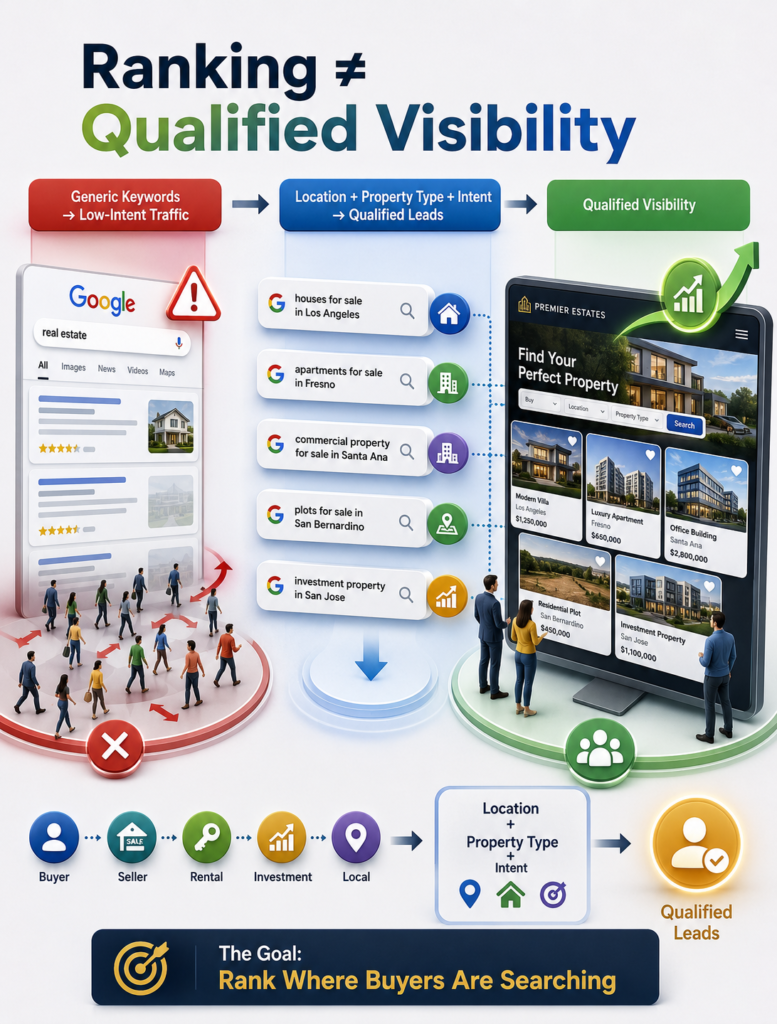
Your website may appear on Google, but that does not mean it is appearing for the searches that can bring you customers.
This is where visibility and qualified visibility become different things.
For example, your real estate website may rank for general terms such as “real estate,” but your potential customers may be searching for:
- houses for sale in Los Angeles
- apartments for sale in Fresno
- commercial property for sale in Santa Ana
- property dealer near me
- plots for sale in San Bernardino
- investment property in San Jose
If your website does not target these types of searches, you may be visible on Google without getting useful leads.
A good keyword strategy starts with understanding search intent. You should know what the person wants when they type a search into Google.
For a real estate business, this can include:
- Buyer intent: someone looking to purchase property
- Seller intent: someone looking to sell a property
- Rental intent: someone looking for a property to rent
- Investment intent: someone researching a property investment
- Local intent: someone looking for a real estate business in a specific area
Your keyword research should consider location, property type, price, buyer intent, seller intent, and investment intent.
Then create useful pages that answer those searches instead of trying to rank every page for the same broad keyword.
The goal is not simply to rank. The goal is to rank where your potential clients are looking.
3. Your Property Pages Have Weak or Duplicate Content
Your property pages are some of the most important pages on a real estate website. They are often the pages where a potential buyer decides whether to ask for more information.
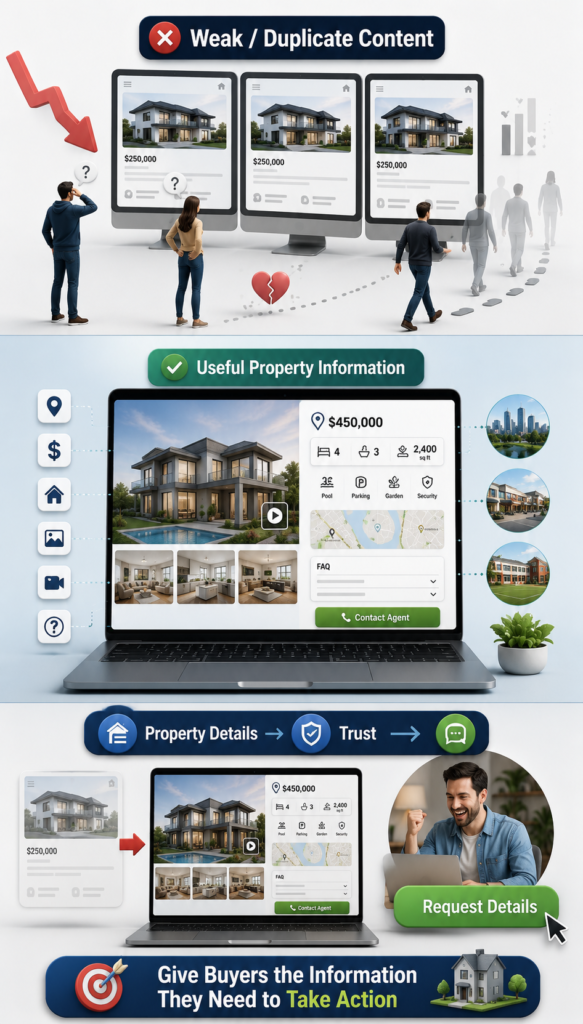
But many real estate websites use very short or repeated descriptions.
For example:
“Beautiful house available for sale. Contact us for more details.”
If you have dozens of property listings with almost the same description, the pages provide very little useful information to either the visitor or Google.
A buyer wants to know what makes the property different. They may want to know the location, property size, number of bedrooms, nearby facilities, price, amenities, and other important details before contacting an agent.
Each useful property page should have its own information, such as:
- Unique property description
- Exact or useful location information
- Price or price range where appropriate
- Property size
- Bedrooms and bathrooms
- Property type
- Amenities
- Nearby locations and landmarks
- High-quality property photos
- Videos or virtual tours where available
- Frequently asked questions
- A clear call to action
Avoid copying the same description from one property page to another.
A strong property page should answer the buyer’s basic questions before asking them to contact you.
This also helps create a better user experience. When visitors find useful and clear property information, they have a stronger reason to stay, trust your business, and make an inquiry.
4. Your Website Does Not Build Enough Trust
Real estate is a high-value business. People may spend a large amount of money on a property, so they usually want to know who they are dealing with before they make a decision.
This is why trust signals are important for real estate lead generation.
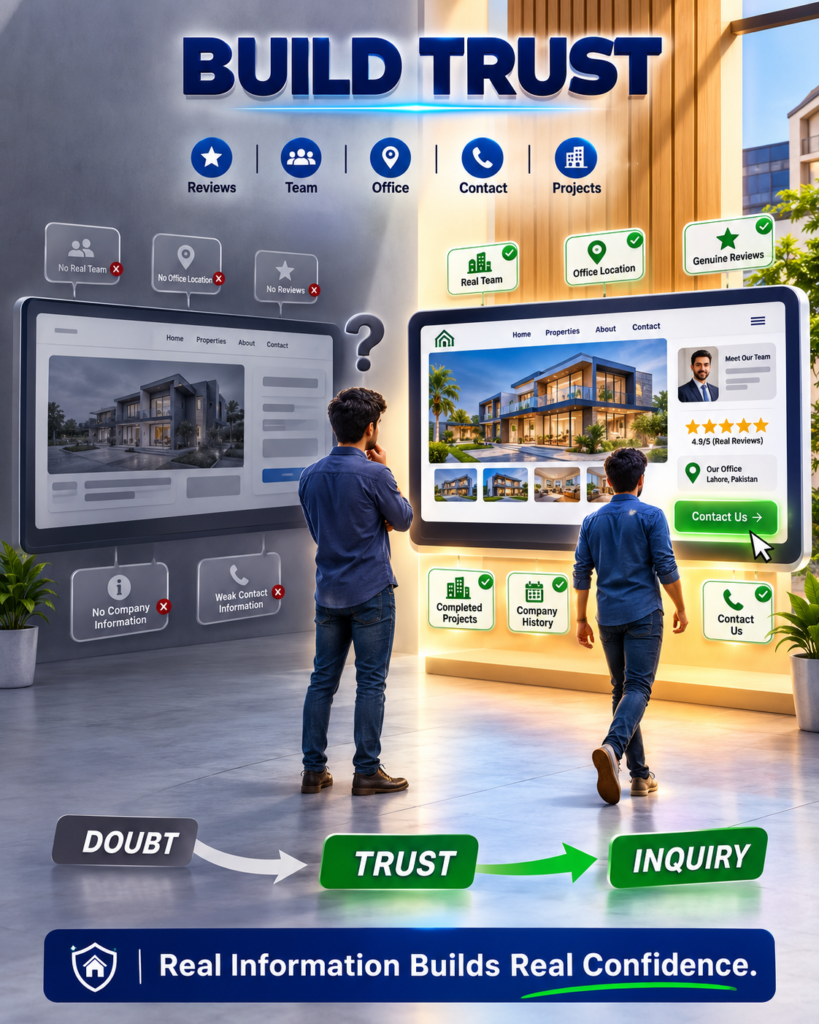
Imagine a visitor finds a property on your website. They like it, but your website does not show who owns the business, where the office is located, who the agents are, whether previous customers are happy, or how long the company has been working in the market.
The visitor may simply leave and contact another real estate agency.
Your website should help answer questions such as:
Who are you?
Where are you located?
What properties do you deal with?
Can previous customers recommend you?
Can I contact a real person?
Useful trust elements can include:
- Customer testimonials
- Genuine Google reviews
- Company history
- Real team information
- Office address
- Contact information
- Completed projects
- Real property photos
- Relevant certifications where applicable
- Helpful information about your local market
Do not add fake reviews or made-up claims. Real estate customers need real information.
Your About Us, Contact, property, and service pages should all work together to build confidence.
The more comfortable a visitor feels with your business, the easier it becomes for that person to take the next step.
6. Contacting You Is Too Difficult
Even when a visitor wants to contact your real estate business, you can lose the lead if the contact process is difficult.
Imagine someone is viewing a property on a mobile phone. They are interested and want to ask about the price. They look for your phone number but cannot find it. They search through the menu and then open your contact page. The page has a form with ten required fields.
Many people will simply leave.
Your contact process should be as simple as possible.
Give visitors easy options such as:
Call → WhatsApp → Short Contact Form
Your phone number should be easy to find. Your WhatsApp option should be visible where it makes sense. Your contact form should ask only for information you actually need.
For example, a simple form could ask for:
- Name
- Phone number
- Property they are interested in
- Message
You can also make important phone numbers clickable on mobile devices.
A sticky call or WhatsApp button can be useful on property pages, especially when a large percentage of your visitors use mobile phones.
Remember that every extra step can create another chance for a potential client to leave.
If contacting your business takes too much effort, your website may be losing leads that were already ready to talk to you.
5. Your Call-to-Action Is Weak or Missing
A visitor can like your property and still leave your website if you do not clearly tell them what to do next.
This is a common problem on real estate websites.
A page may contain beautiful property photos and detailed information, but at the bottom there is only a small button saying:
“Submit.”
That does not tell the visitor what will happen next.
A real estate website needs clear calls to action (CTAs) that match the visitor’s needs.
For example:
- Schedule a Property Viewing
- WhatsApp an Agent
- Request Property Details
- Book a Consultation
- Get Property Price
- Talk to an Agent
- Request More Information
Different visitors may be at different stages of the buying process. Someone may not be ready to buy today but may still want to ask a question or schedule a viewing.
Make the next step easy and clear.
For example, instead of:
Submit
use:
Request Property Details
Instead of hiding your phone number in the footer, make it easy to find on important pages.
Instead of asking every visitor to complete a long form, give them simple choices such as Call, WhatsApp, or Send an Inquiry.
A clear CTA removes confusion and helps turn website visitors into real estate leads.
8. Your Website Is Too Slow
A slow website can hurt both the user experience and your lead generation.
Real estate websites often contain many large property images, videos, sliders, maps, tracking scripts, plugins, and other website features. If these elements are not optimized, pages can take too long to load.
A visitor who is waiting for a property page to open may decide to go back to Google and visit another website.
Common causes of a slow real estate website include:
- Very large property images
- Unoptimized images
- Too many plugins
- Unnecessary scripts
- Poor caching
- Poor hosting or server performance
- Heavy themes or page builders
- Unoptimized CSS and JavaScript
You can improve performance by compressing property images and using modern image formats such as WebP or AVIF where appropriate. Caching, better hosting, and reducing unnecessary scripts can also help.
You should also monitor Core Web Vitals and other performance signals using appropriate testing tools.
The goal is simple: when someone clicks a property listing, the page should load quickly and allow them to start reading and viewing the property without unnecessary waiting.
A faster website creates a better experience and gives potential clients fewer reasons to leave.
7. Your Website Is Poor on Mobile Devices
Many people search for properties using their smartphones. They may browse houses, apartments, plots, and commercial properties while travelling, during a break, or while sitting at home.
If your website looks good on a desktop but is difficult to use on a mobile phone, you can lose potential clients.
Look at your website from a real mobile device and check simple things.
Can visitors read the text easily?
Can they tap the buttons without zooming in?
Can they open the property photos?
Can they use the contact form?
Can they find your phone number and WhatsApp option?
Is the menu easy to understand?
Watch for problems such as:
- Very small text
- Buttons that are difficult to tap
- Slow property images
- Confusing navigation
- Horizontal scrolling
- Forms that are difficult to complete
- Content that goes outside the screen
A mobile-friendly website should make it easy for a visitor to browse property listings and contact your business without struggling.
Do not only test the homepage. Check your main landing pages, property pages, contact page, and important service pages.
A simple mobile test can reveal problems that may be costing you leads every day.
10. Your Website Gives Buyers Too Little Information
One of the simplest reasons a real estate website may not get leads is that visitors cannot find enough information to make a decision.
For example, a property page may say:
“Contact us for price.”
But the visitor may also want to know:
- Where is the property?
- How large is it?
- How many bedrooms does it have?
- What is the price?
- What amenities are included?
- Is it ready for possession?
- What is nearby?
- Can I see more photos?
- Can I arrange a viewing?
When basic information is missing, the visitor has to work harder to understand the property.
Some people will contact you and ask questions. Others will simply leave and find another property website that gives them the information they need.
Give buyers as much useful and accurate information as possible, including:
- Price or price range where appropriate
- Location
- Property size
- Bedrooms
- Bathrooms
- Property type
- Amenities
- Possession or availability status
- Nearby landmarks
- High-quality photos and videos
- Floor plans where available
- Financing information where relevant
- Property viewing process
You do not need to hide every useful detail just to make people contact you.
Instead, give visitors enough information to understand the property and then make the next step easy.
For example:
View Property Details → Schedule a Viewing → Talk to an Agent
This approach helps build trust and makes the website more useful for real buyers, sellers, tenants, and investors.
The better your website answers a visitor’s questions, the stronger the chance that the visitor will stay, trust your business, and become a qualified real estate lead.
9. Your Website Does Not Target Local Buyers
Real estate is strongly connected to location.
A person looking for a property usually cares about a particular city, area, neighborhood, or community. This means a real estate website should not only talk about properties in general. It should show clear relevance to the locations it serves.
Think about your website structure like this:
City → Area → Neighborhood → Property Type
For example, instead of having one general page about real estate, you may create useful pages around real search needs, such as:
- Real Estate in Elk Grove
- Properties for Sale in Santa Rosa
- Houses for Sale in Oxnard
- Apartments for Sale in Santa Clarita
- Commercial Property in Moreno Valley
These pages should contain genuinely useful information about the location and properties available there.
Do not create hundreds of almost identical location pages just to target keywords. This can create thin content that provides little value.
A useful local page can explain the types of properties available, important nearby locations, property prices or ranges where reliable, local facilities, buyer considerations, and the services your real estate business provides in that area.
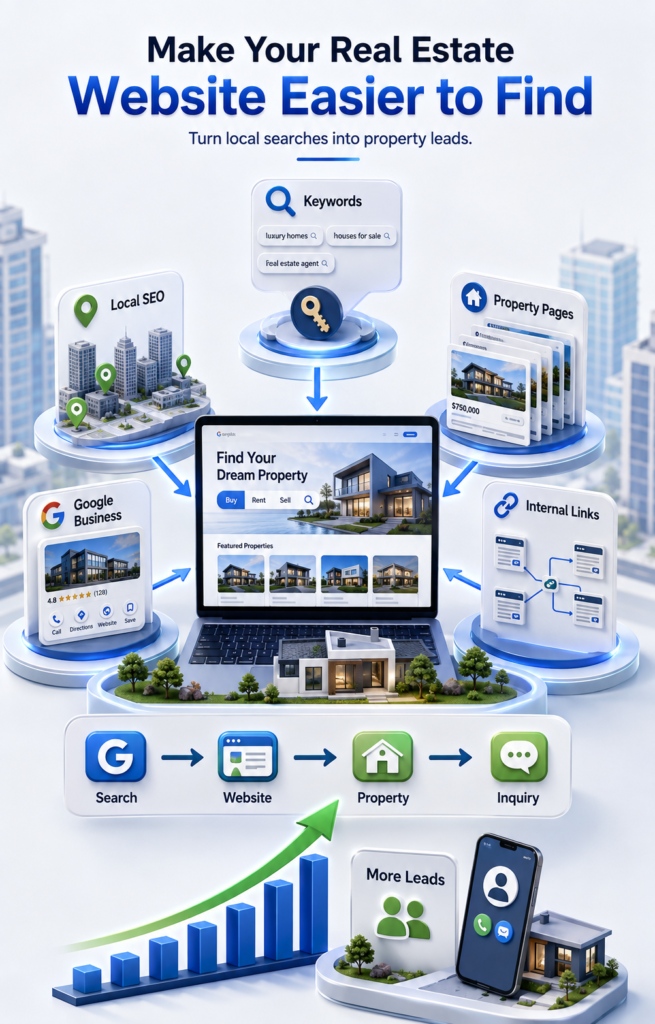
Local SEO should also include your Google Business Profile, business information, reviews, local keywords, and relevant location signals.
When your website clearly tells Google and potential customers where you operate, it becomes easier to connect your business with relevant local searches.
How to Turn a Real Estate Website Into a Lead-Generating Website
Once you find why your real estate website is not getting leads, the next step is to fix the areas that are stopping visitors from becoming potential clients. A good real estate website should do more than show property listings. It should bring the right people to your website, answer their questions, build trust, and make it easy to contact your business.
Build Pages Around Buyer Intent
Create pages for what your potential clients are actually searching for. Target searches based on location, property type, price, and buyer intent. Pages such as “Houses for Sale in Oakland” can attract people who are already looking for a property.
Optimize Your Property Listing Pages
Give every property page useful and unique information. Include the location, price, property size, bedrooms, bathrooms, amenities, photos, nearby places, FAQs, and a clear CTA. Avoid using the same description on multiple property listings.
Create Location-Based Content
Build useful pages around the cities, areas, and neighborhoods your real estate business serves. Explain the local property market, available property types, nearby facilities, and other information that helps buyers make a decision.
Add Strong CTAs
Tell visitors what they can do next. Instead of a simple “Submit” button, use clear actions such as Schedule a Property Viewing, WhatsApp an Agent, Request Property Details, or Talk to an Agent.
Make Contact Options Easy
Make your phone number, WhatsApp button, and contact form easy to find. Keep forms short and make phone numbers clickable on mobile devices. Do not make visitors search through several pages just to contact you.
Build Trust
Show genuine customer reviews, testimonials, company information, team details, office information, completed projects, and real property photos. Clear and honest information helps potential buyers feel more comfortable contacting your real estate business.
Improve Mobile UX
Test your website on real smartphones. Make sure text is readable, buttons are easy to tap, property images work properly, menus are simple, and forms are easy to complete. A good mobile experience can help prevent visitors from leaving.
Improve Page Speed
Compress large property images, use suitable modern image formats, improve caching, remove unnecessary scripts, and use reliable hosting. Monitor website performance and Core Web Vitals to find pages that need improvement.
Track Conversions
Do not only track website traffic. Track actions that can become real leads, such as phone calls, WhatsApp clicks, contact form submissions, consultation requests, and property viewing requests. This shows which pages are actually helping your business.
Real Estate Website Lead Generation Checklist
Use this checklist to quickly review your real estate website. You do not need to fix everything at once. Start with the areas where your website is weakest, then work through the list step by step.
SEO Checklist
- Target keywords identified: Make sure you know which keywords your potential buyers, sellers, tenants, and investors use when searching for real estate services and properties.
- Location keywords targeted: Target useful searches related to your city, areas, and neighborhoods, such as “houses for sale in Los Angeles” or “property dealer in San Francisco”
- Property pages optimized: Each property listing should have useful, unique content, relevant keywords, clear property details, images, and a strong call to action.
- Internal links added: Link related property, location, service, and real estate SEO pages together so users and search engines can easily discover important content.
- Google Business Profile optimized: Keep your business name, address, phone number, services, photos, reviews, and other business information accurate and up to date.
- Search Console monitored: Check Google Search Console for impressions, clicks, search queries, indexing problems, and pages that are gaining or losing visibility.
Website Checklist
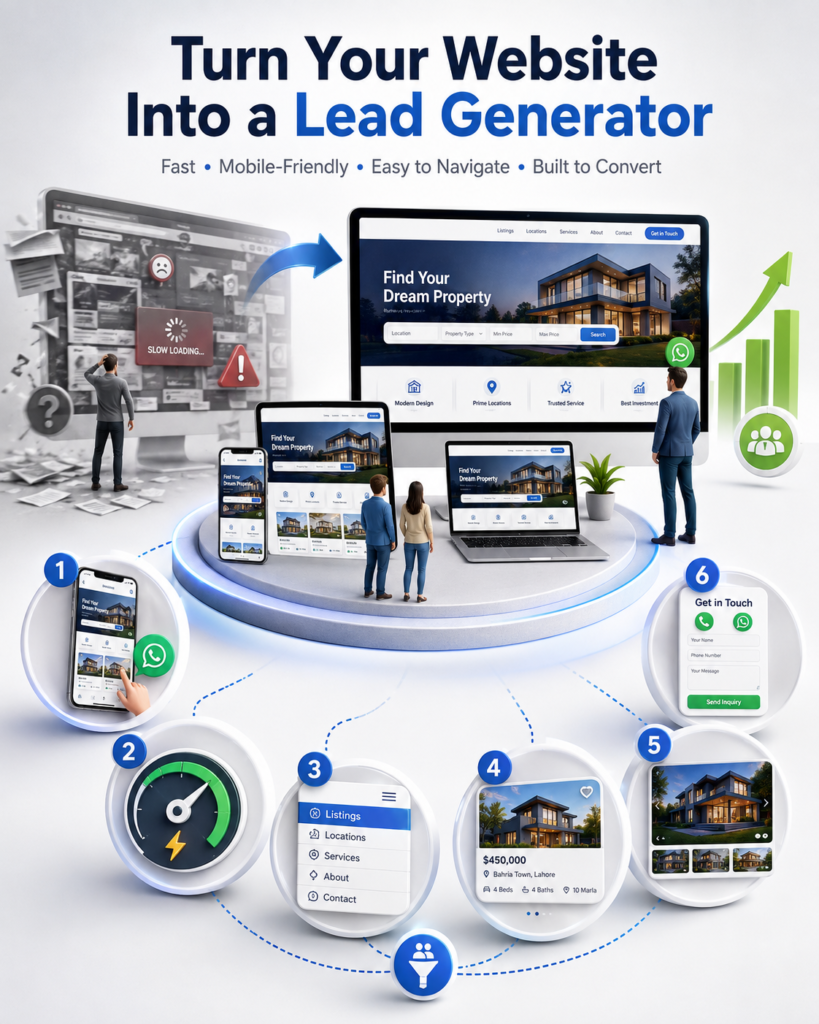
- Mobile friendly: Make sure visitors can browse property listings, read content, and contact your business easily from a smartphone.
- Fast loading: Optimize large property images, caching, scripts, and other website elements that may slow down your pages.
- Easy navigation: Visitors should quickly find property listings, locations, services, About Us, Contact, and other important pages.
- Clear property information: Give buyers useful details such as price, location, property size, bedrooms, bathrooms, amenities, availability, and viewing information where applicable.
- High-quality images: Use clear, genuine property photos that help visitors understand the property before contacting your business.
- Clear contact information: Make your phone number, WhatsApp option, email, and contact form easy to find on important pages.